
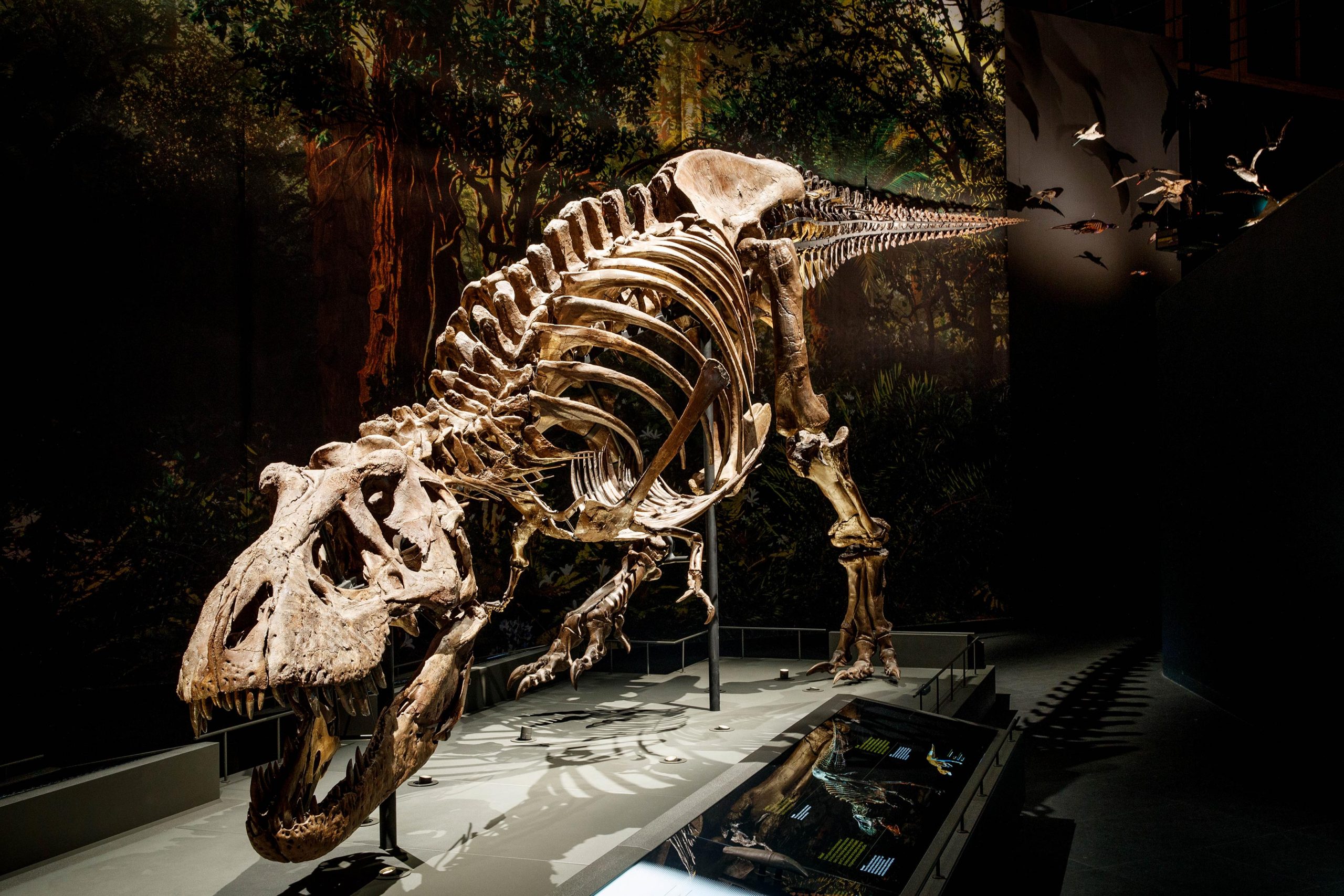
New modeling suggests T. rex walked at a relaxed pace of 4.6 km/h, thanks to energy-efficient tail resonance—comparable to a human walking speed.
Humans and animals have a preferred walking speed. This is, in part, influenced by the amount of energy required: they prefer to walk at the speed at which they use the lowest possible amount of energy. One of the ways to achieve this is using something called resonance.
You already know how it works: when you are on a swing, you can’t just swing at any speed. If you want to do it properly, you have to get the timing right, and swing in the rhythm of the swing. In other words: you have to resonate with it. And when you’re on a nice relaxing walk, the parts of your body resonate, too. Walking slightly slower doesn’t require less energy: you notice that it’s actually harder.
An animation of T.rex Trix walking according to the simulations in Van Bijlert et al 2021. The tail is resonating, allowing for a more realistic, slightly slower gait. Credit: Rick Stikkelorum, Arthur Ulmann & Pasha van Bijlert
This works for animals that walk on four feet, and for two-legged animals like humans and ostriches. Pasha van Bijlert, student Human Movement Sciences at the Vrije Universiteit in Amsterdam (VU), applied the idea to an animal that walked differently from anything walking the earth right now: Tyrannosaurus rex. These carnivorous dinosaurs didn’t just have two legs, they also had an enormous tail that helped them move around.
Tail Mechanics Key to Tyrannosaurus rex Locomotion
Like the bones in our necks, the bones in tails are held together by ligaments. “You could compare it with a suspension bridge,” Van Bijlert explains. “A suspension bridge with a ton of muscle in it.” Every step the tail swings up and down. That means that like the swing, it has a natural frequency at which it resonates.
To find out what that frequency is, Van Bijlert and his professors Anne Schulp (Naturalis/Utrecht University) and Knoek van Soest (VU) built a 3D model of Trix, the Tyrannosaurus rex on display at the Dutch National Museum of Natural History, Naturalis. They added digital muscles to the famous skeleton, and on this muscular model they could perform biomechanical analyses. From these, they derived the natural frequency and a preferred walking speed: 4.6 km/h (2.9 mph). So, when Trix was out on a stroll, she walked at roughly the same speed as you do. If you had a pet T. rex, you would have no problem walking it — in terms of speed, at least.
Van Bijlert, Van Soest and Schulp published their findings in the journal Royal Society Open Science today (April 21, 2021). “There were already some studies investigating dinosaur walking speed, but they mostly looked at the legs and ignored the tail — which is what makes dinos so unique,” Van Bijlert says. “They usually found much higher walking speeds. The one we calculated is lower, but it’s similar to that of other animals.”
Reference: “Natural Frequency Method: estimating the preferred walking speed of Tyrannosaurus rex based on tail natural frequency” by Pasha A. van Bijlert, A. J. ‘Knoek’ van Soest and Anne S. Schulp, 21 April 2021, Royal Society Open Science.
DOI: 10.1098/rsos.201441
Never miss a breakthrough: Join the SciTechDaily newsletter.
Follow us on Google and Google News.
11 Comments
So how fast could T-Rex RUN???
I second Harry’s question about running speed. If they couldn’t run very fast, would that confirm that they were more likely scavengers than hunters?
how fast did it run tho???
Hmm, reminds me of gators in my world. That tail of theirs contributes greatly to their land speed. It moves side to side instead of up and down but it does move to avoid acting as a drag on the gator’s speed. Or so it seems to me. Bet your dino could pour on the speed when inclined to do so and perhaps for just as short a burst as the gator.
This is study is wrong because it is base on the view of the skeleton as a series of levers. However there are no fulcrums in skeletons. The tail of the beast is integrally connected to the rest of the musculoskeletal system acting like a tensegrity like structure (of elastegrity to be more precise). It is time to update the Borelian mechanics need to be updated.
Sorry for the multiple typos in my haste. There is no way to go back and fix.
@Harry They could run really fast, according to other studies. Probably in the range of 30 or 40 mph — about twice as fast as a human being. Maybe only for short distances, though. It’s interesting to know that they walked very slowly, but that doesn’t tell us much about their abilities as predators.
Maybe their walking slowly and efficiently conserved their energy for the burst of speed necessary to take down fleeing prey, sorta like the big cats of our day. Some say T’s usually ate carrion, but with a mouth like that I can’t believe that they just moseyed about from carrion to carrion finds to subsist. That mouth is made for killing.
But T-Rex runs so fast in the Dinosaur Game in the Chrome browser!
Perhaps they behaved similarly to cheetahs? Moving slow and conserving energy until an opportunity arose?
While I do believe that they were primarily scavengers, I do not doubt that they did not pass up an opportunity to hunt weakened or old prey, I also don’t doubt that when faced with a herd of prey that could fight back that the trex would consider other options.
I like to picture trex’s with much thicker legs then shown, much more power/muscle. I picture them closer to the build of a pitbull, that is if the pitbull had no front legs. I would imagine it needed much more leg strength to hold it’s body up just by size alone, the tail would help with weight.
Word Loki👍 There are marks and damage to the skeleton in the legs, which indicates that the T-rex, just like the cheetahs, could show explosive strength at short intervals.
The legs do not seem to be places in the center of gravity. Just like a duck, so then it probably just has to be accepted, since T-rex is essentially a big duck.
I think this thin-legged T-rex looked a little weird. The movement in the tail was nice, but how the legs jumped into a straight up position, looked unnatural